How to Understand Math in Depth—Not Just Memorize Formulas
Real math mastery means knowing why a method works, not just when to plug it in. Learn the difference between memorization and understanding, plus practical techniques to build durable mathematical intuition.
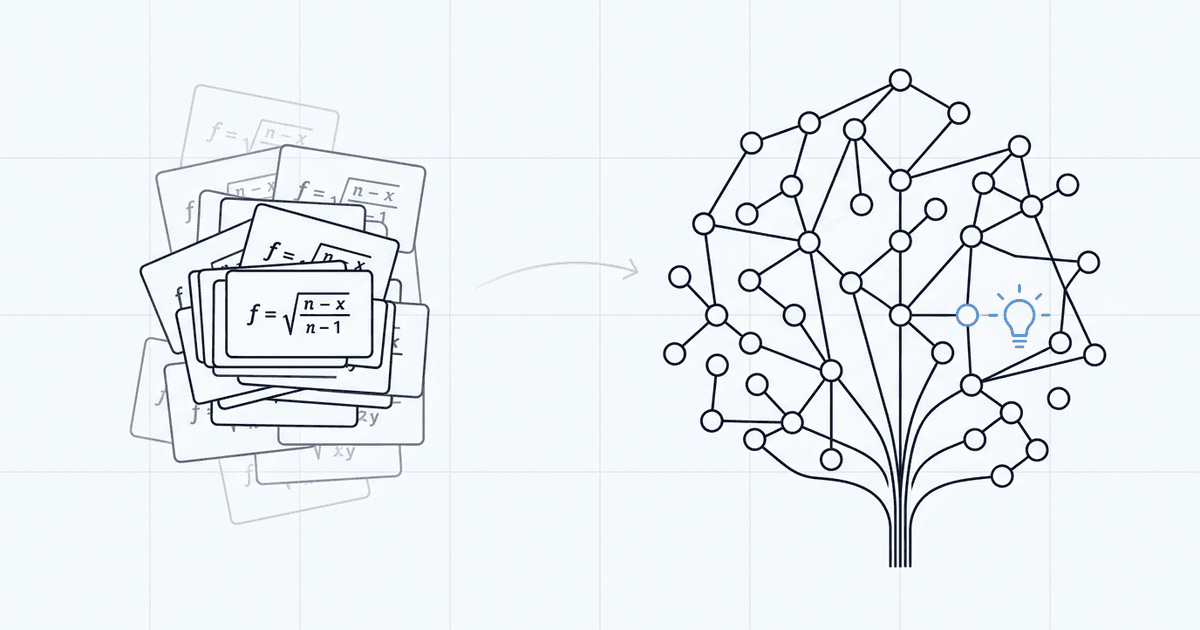
Direct answer: Understanding math in depth means you can explain why a technique works, predict what happens when conditions change, and solve unfamiliar problems by reasoning from definitions—not by hunting for a memorized template. Memorization gives you speed on familiar drills; understanding gives you resilience when the exam changes the setup.
Most students who say they "aren't a math person" are often memorizing without structure. They can reproduce steps on homework that mirrors the textbook, then freeze when the problem is rephrased, combined with another idea, or stripped of cues. That gap is not a talent ceiling. It is usually a study-method gap.
Memorization vs. Understanding: What Actually Differs
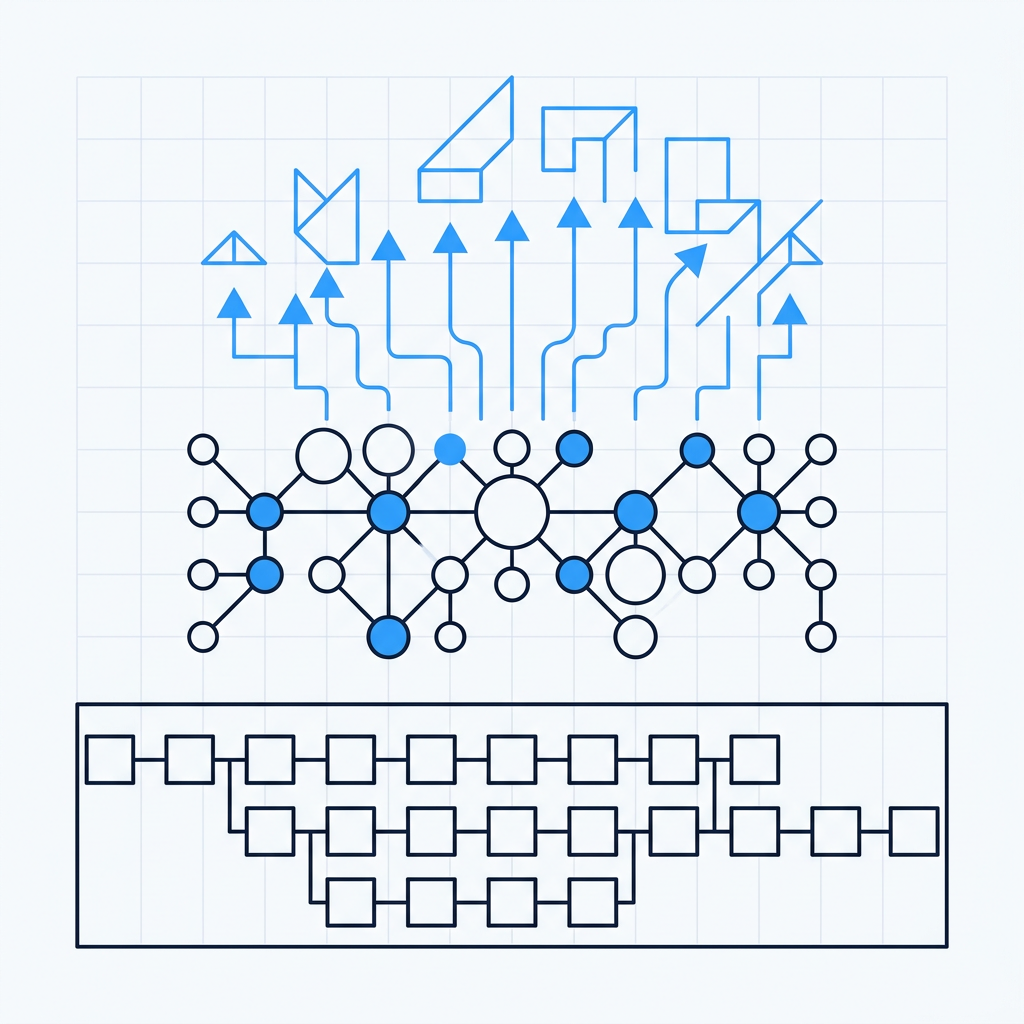
Memorization stores labels and sequences: the quadratic formula, the derivative of sine, the steps for partial fractions. That storage is useful—experts still memorize key results. But memorization alone treats math like a playlist: you can replay tracks you have heard, not compose new ones.
Understanding stores relationships: how a formula connects to a picture, what assumption makes a theorem true, which simpler idea the hard problem is secretly built from. When you understand, you can derive what you forgot instead of panicking, check answers for plausibility, and transfer tools to new contexts.
A quick self-test after any section: close the book and ask (1) what problem class this tool solves, (2) what would break if a hypothesis changed, and (3) how you would explain it to someone who only knows arithmetic. If you can only recite steps, you are still at the memorization layer.
Three Layers of Math Mastery
Think of depth as a stack—not a single switch.
Layer 1 — Procedural fluency. You can execute algorithms: row-reduce a matrix, integrate by parts, factor a polynomial. Fluency matters; it frees working memory for harder decisions. But fluency without meaning collapses under novelty.
Layer 2 — Conceptual structure. You know definitions, diagrams, and logical dependencies. You see that integration is accumulation, that eigenvectors are directions unchanged by a transformation, that a proof is a chain of permitted moves. This layer turns isolated tricks into a map.
Layer 3 — Transfer and creation. You choose methods on ambiguous problems, combine ideas across chapters, and invent reasonable approaches when no example matches. Exams and real applications live here.
Study tactics should climb the stack deliberately. Do not skip Layer 1—but never stop at Layer 1.
The Feynman Loop: Explain, Gap, Repair, Simplify
Richard Feynman’s learning heuristic is brutally effective for math: teach it in plain language. The loop is simple:
- Pick one idea (not a whole chapter).
- Explain it aloud or on paper without notation first, then add symbols.
- Mark every pause, hand-wave, or "it just works"—those are gaps.
- Return to the source (text, notes, office hours) and fix one gap at a time.
- Simplify the explanation until a skeptical friend would nod.
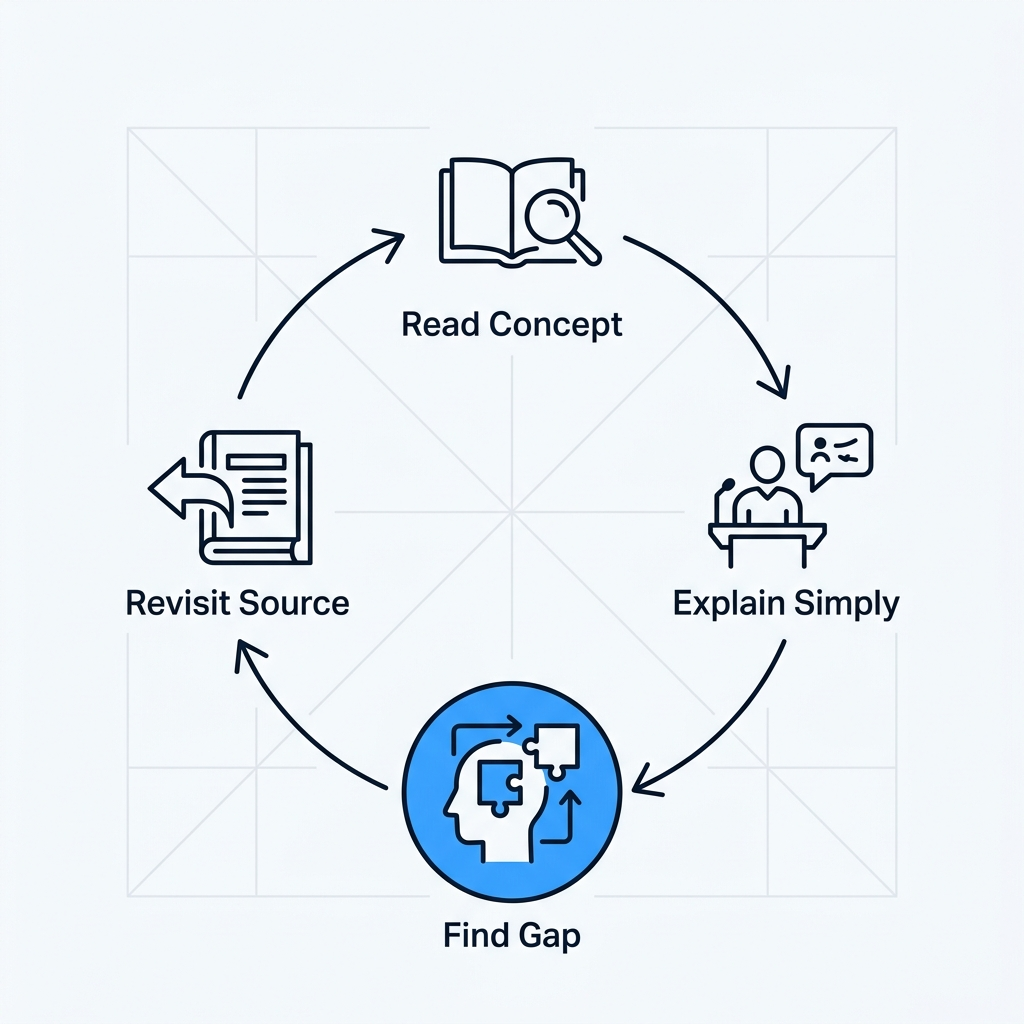
If your explanation relies on magic steps, you have discovered the exact pages worth re-studying. Gaps are data, not failure.
Work From Definitions, Not From Vibes
Deep understanding anchors in definitions and theorems you can state precisely. Before practicing twenty similar exercises, spend ten minutes rewriting core definitions from memory and noting what each quantifier (∀, ∃) is doing.
When stuck on a proof or word problem, ask: What am I trying to construct or show? Which definition matches that goal? Students who jump straight to formulas often choose the wrong tool because they skipped the translation step from English to mathematics.
Why "More Examples" Sometimes Fails
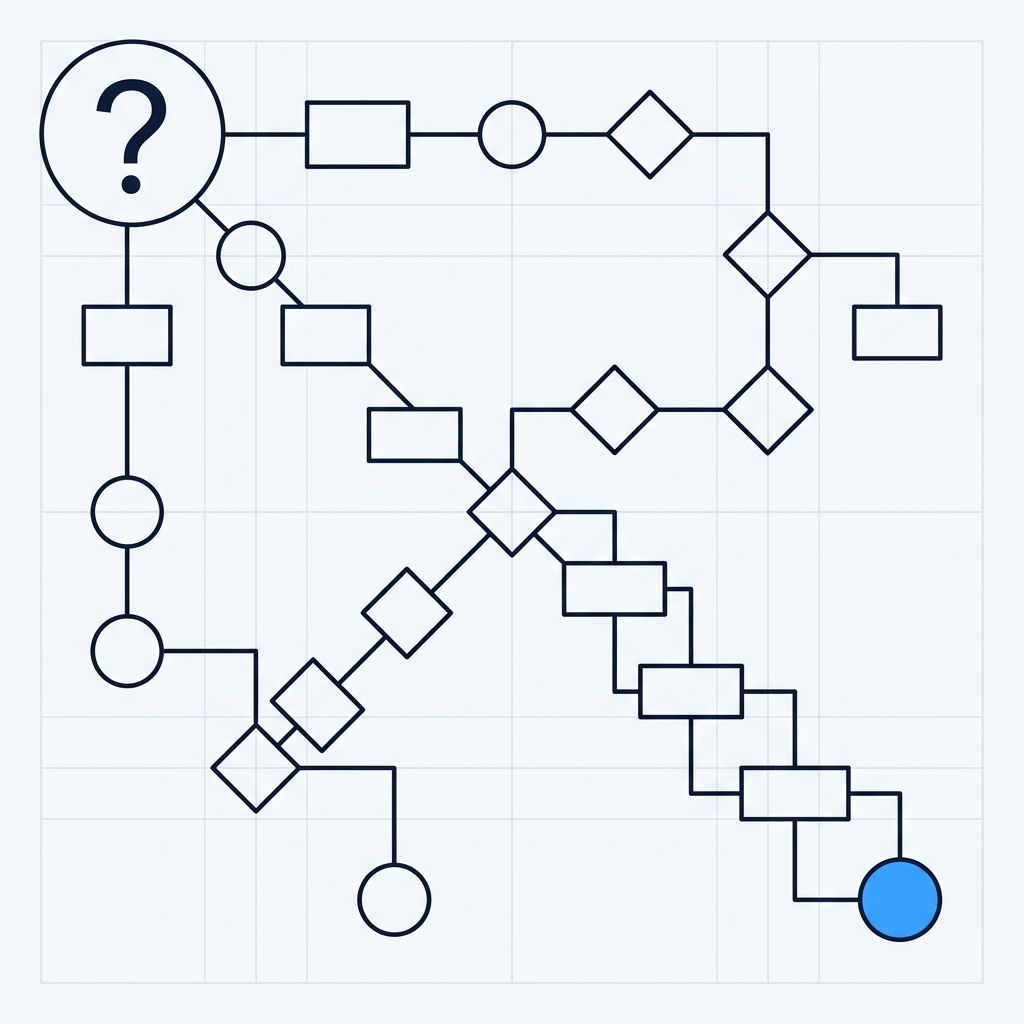
Worked examples help—until they become pattern-matching drills. Watching a solution is passive; producing one is active. After studying an example, cover the solution and rebuild it. Change one number or condition: does your method still work? If not, articulate why.
Alternate forward practice (solve) with backward practice (given an answer, what question could produce it?) and error analysis (find the deliberate mistake in a flawed solution). These modes force understanding of structure, not just final lines.
Common Traps That Feel Like Understanding
- Highlighting fluency: the page looks familiar, but you cannot reproduce key ideas.
- Symbol pushing: you manipulate algebra quickly without knowing what objects represent.
- Category errors: you memorize "when I see X, use Y" without checking assumptions.
- Calculator camouflage: tools hide weak estimation and number sense.
- Solution tourism: copying step-by-step apps without closing the book and redoing the problem.
Each trap mimics progress. The antidote is the same: close resources, produce, verify, reflect.
A Weekly Study Rhythm for Depth
Before lecture: skim definitions; note what feels undefined in plain words.
After lecture (same day): twenty minutes of retrieval—explain one theorem, redo one example from memory, write a one-sentence "why this matters."
Problem-set days: attempt fresh problems before rereading; use references only after a honest attempt.
Weekly consolidation: one page of links—how this week’s topic connects to last week’s. Math courses are cumulative; isolated weeks decay.
Before exams: mixed problem sets spanning old units. Interleaving feels harder and works better than blocking by chapter.
Using Tools Without Replacing Thinking
Apps and solvers can accelerate checking, but depth requires you to carry the reasoning. A useful rule: after any automated help, close the tab and rebuild the solution on paper, narrating why each step is legal.
For syllabus-aligned practice that tests whether you understand relationships in your own materials—not generic trivia—Studeum can generate quizzes and flashcards from your PDFs and notes. Use them to find gaps early: missed quiz items become a targeted reading list, not a surprise on exam day.
Questions to Ask on Every New Topic
- What is the simplest example where this idea appears?
- What is a non-example (close but invalid)?
- What visual or story makes the definition intuitive?
- Which earlier course idea is this a special case of?
- If the professor removed one hypothesis, what breaks?
Keep these questions in the margin. Over a semester they train you to think like the subject, not like a flashcard deck.
When to Seek Human Help
If the same misconception survives three honest attempts, schedule office hours with one specific gap—a definition, a step, a counterexample—not "I don't get chapter five." Tutors and professors can dismantle a precise misunderstanding quickly; vague distress consumes time.
The Long Game
Depth is not slower forever. Early weeks feel heavier because you are building schemas—mental file systems. Later topics snap in faster when they attach to structures you actually understand.
Memorization gets you through tomorrow's quiz. Understanding gets you through next year's course, the lab that assumes this math, and the job where nobody labels problems by chapter.
Choose one idea tonight. Explain it in plain language, find one gap, fix it, and attempt one problem without looking. That ten-minute loop, repeated, is how memorization graduates into mastery.
Last updated: June 28, 2026.