How to Understand Physics in Depth—Not Just Memorize Formulas
Real physics mastery means knowing why a law holds, not just when to plug numbers in. Learn the difference between memorization and understanding, plus practical techniques to build durable physical intuition.
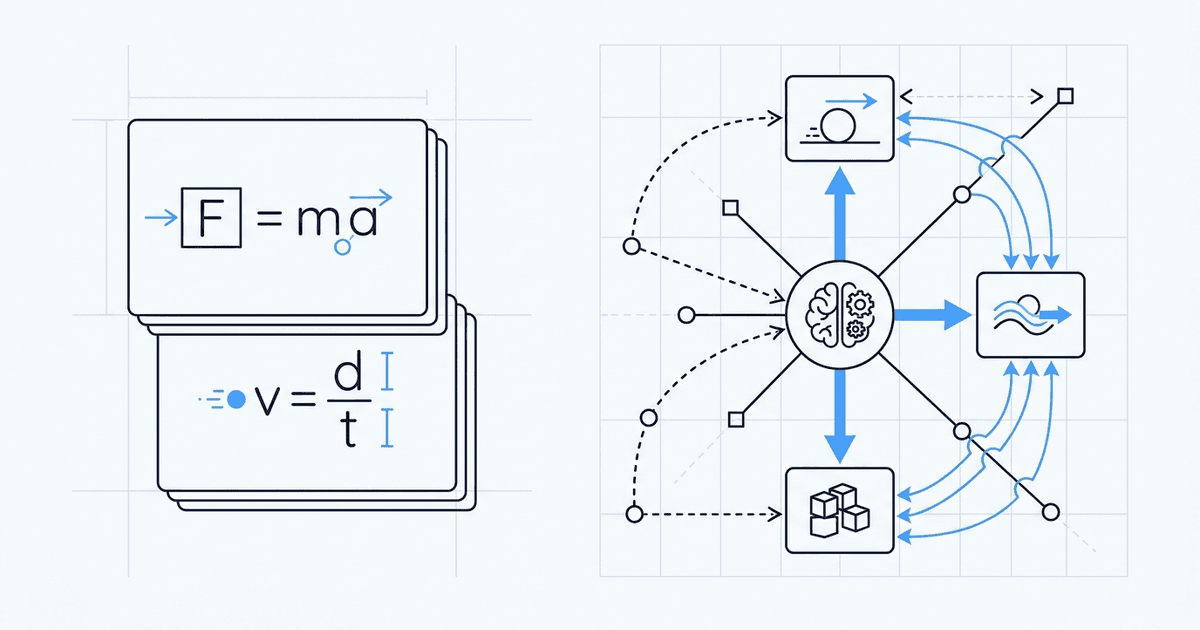
Direct answer: Understanding physics in depth means you can explain why a law applies, predict what changes when a condition shifts, and solve unfamiliar problems by reasoning from principles—not by hunting for a memorized template. Memorization gives you speed on familiar drills; understanding gives you resilience when the exam swaps the setup or hides the cue words.
Most students who say they "aren't a physics person" are often memorizing without structure. They can reproduce steps on homework that mirrors the textbook, then freeze when the problem combines two topics, uses a weird coordinate choice, or asks why instead of how much. That gap is not a talent ceiling. It is usually a study-method gap.
Memorization vs. Understanding: What Actually Differs
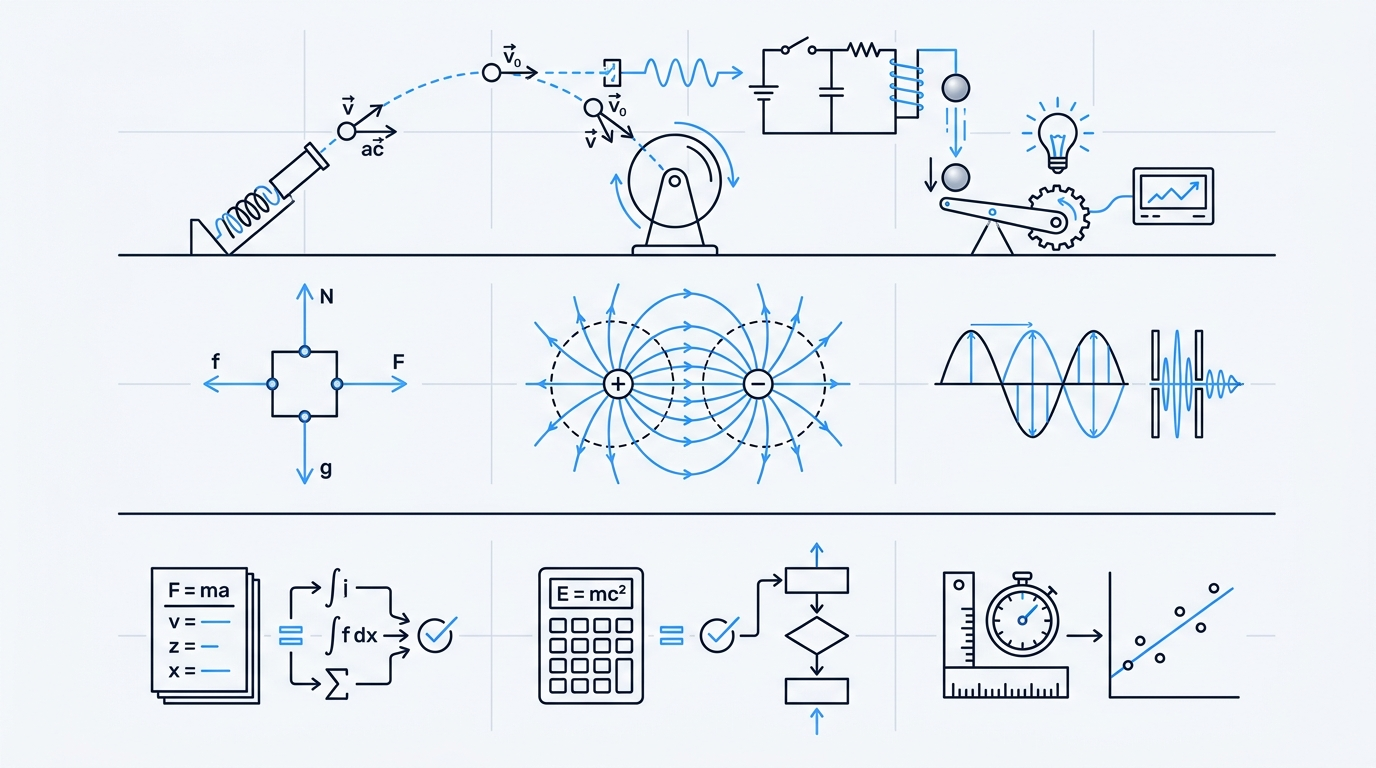
Memorization stores labels and recipes: (F = ma), the kinematic equations, the right-hand rule, the steps for a lens ray diagram. That storage is useful—experts still memorize key results. But memorization alone treats physics like a playlist: you can replay tracks you have heard, not compose new ones when the situation changes.
Understanding stores relationships: how a force diagram connects to acceleration, what assumption makes energy conservation valid, which simpler model the messy problem reduces to. When you understand, you can derive what you forgot instead of panicking, check answers with units and limiting cases, and transfer tools to setups you have never seen labeled by chapter.
A quick self-test after any section: close the book and ask (1) what physical situation this tool describes, (2) what would break if you removed friction, symmetry, or the "small angle" assumption, and (3) how you would explain it to someone who only knows everyday motion. If you can only recite steps, you are still at the memorization layer.
Three Layers of Physics Mastery
Think of depth as a stack—not a single switch.
Layer 1 — Procedural fluency. You can execute standard moves: draw a free-body diagram, apply Gauss's law in the right symmetry, use Snell's law, set up a circuit loop. Fluency matters; it frees working memory for harder decisions. But fluency without meaning collapses under novelty.
Layer 2 — Conceptual structure. You know what quantities are—momentum as "how hard motion is to stop," fields as "what space knows about charges," waves as coupled oscillations. You see how ideas depend on each other: Newton's laws before friction tricks, potential before capacitors, superposition before interference patterns. This layer turns isolated formulas into a map.
Layer 3 — Transfer and modeling. You choose approximations on ambiguous problems, combine ideas across units, and build a model when no example matches. Real exams, labs, and engineering problems live here.
Study tactics should climb the stack deliberately. Do not skip Layer 1—but never stop at Layer 1.
The Feynman Loop: Explain, Gap, Repair, Simplify
Richard Feynman—the physicist students quote most often for study advice—built intuition by teaching ideas in plain language. The loop is simple:
- Pick one idea (not an entire chapter).
- Explain it aloud or on paper without equations first, then add symbols.
- Mark every pause, hand-wave, or "it just works"—those are gaps.
- Return to the source (text, notes, office hours) and fix one gap at a time.
- Simplify the explanation until a skeptical friend would nod.

If your explanation relies on magic steps—"then you use equation 4"—you have discovered the exact pages worth re-studying. Gaps are data, not failure.
Work From Principles, Not From Cue Words
Deep understanding anchors in principles you can state precisely: Newton's laws, conservation laws, Maxwell's equations in the appropriate limit, the meaning of each term in a wave equation. Before grinding twenty similar problems, spend ten minutes rewriting those principles from memory and noting what each symbol represents physically.
When stuck on a word problem, ask: What is the system? What interacts with it? Which conserved quantity or balance law applies? Students who jump straight to formulas often choose the wrong tool because they skipped the translation step from English to physics.
Diagrams Are Not Decoration
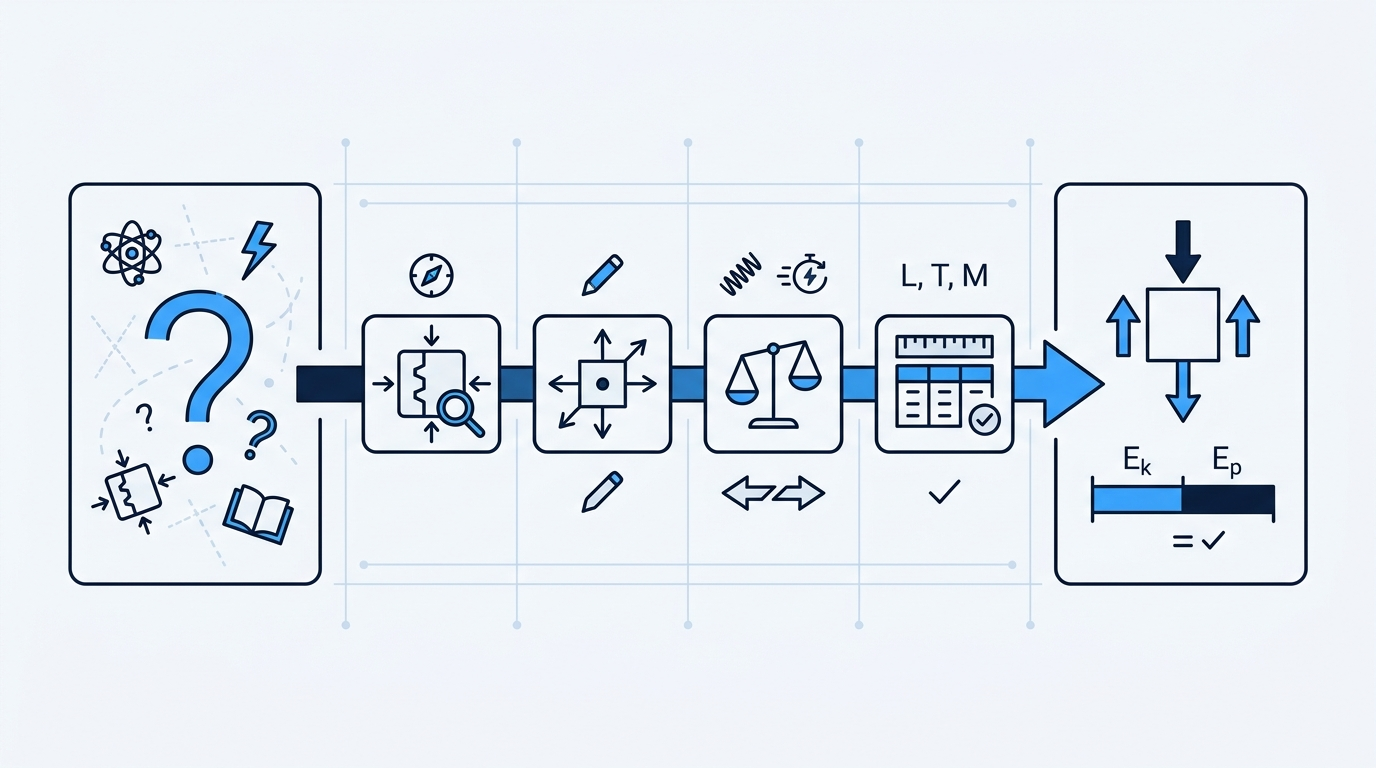
In physics, drawing is thinking. A good free-body diagram, ray sketch, or field picture often is half the solution. If you cannot draw the situation, you probably do not yet understand it.
Make diagrams mandatory on every problem—even when the final answer is a number. Label forces, choose coordinates deliberately, and mark what you are treating as negligible (and why). When your diagram and algebra disagree, trust the diagram first; algebra errors are common, but backwards diagrams reveal conceptual holes.
Dimensional Analysis and Limiting Cases
Two underused checks separate memorizers from understanders:
Dimensional analysis: Does your answer have the right units? Can you explain why each step preserves dimensions? If you cannot, you may be adding apples to meters.
Limiting cases: What happens when mass → 0, velocity → 0, or angle → 90°? Does your formula reduce to something you already trust? A result that fails a sane limit is wrong—even if the algebra looked fine.
These checks take seconds and catch both careless mistakes and deep misunderstandings.
Why "More Examples" Sometimes Fails
Worked examples help—until they become pattern-matching drills. Watching a solution is passive; producing one is active. After studying an example, cover the solution and rebuild it—including the diagram. Change one condition: remove friction, tilt the plane, swap series for parallel. Does your method still work? If not, articulate why.
Alternate forward practice (solve) with backward practice (given an answer, what question could produce it?) and error analysis (find the deliberate mistake in a flawed solution). These modes force understanding of structure, not just final numbers.
Common Traps That Feel Like Understanding
- Highlighting fluency: the page looks familiar, but you cannot reproduce key ideas.
- Formula hunting: you scan for a matching shape instead of modeling the situation.
- Plug-and-chug: numbers go in, answers come out, nothing is checked for plausibility.
- Vocabulary without mechanism: you can say "entropy increases" but not explain what that means for a heat engine.
- Solution tourism: copying step-by-step apps without closing the book and redoing the problem.
Each trap mimics progress. The antidote is the same: close resources, produce, verify, reflect.
A Weekly Study Rhythm for Depth
Before lecture: skim the central principles; note what feels vague in plain words.
After lecture (same day): twenty minutes of retrieval—explain one law, redraw one diagram from memory, write a one-sentence "what would change if…"
Problem-set days: attempt fresh problems before rereading; use references only after an honest attempt.
Weekly consolidation: one page of links—how this week's topic connects to last week's. Mechanics feeds E&M; waves echo in quantum; isolated weeks decay.
Before exams: mixed problem sets spanning old units. Interleaving feels harder and works better than blocking by chapter.
Using Tools Without Replacing Thinking
Simulators, solvers, and videos can clarify phenomena, but depth requires you to carry the reasoning. A useful rule: after any automated help, close the tab and rebuild the solution on paper, narrating why each step is physically allowed.
For syllabus-aligned practice that tests whether you understand relationships in your own materials—not generic trivia—Studeum can generate quizzes and flashcards from your PDFs and notes. Use them to find gaps early: missed quiz items become a targeted reading list, not a surprise on exam day.
Questions to Ask on Every New Topic
- What is the simplest physical setup where this idea appears?
- What is a near-miss (looks similar but the law does not apply)?
- What diagram or demo makes the idea intuitive?
- Which earlier principle is this a special case of?
- If the professor removed one assumption—no friction, uniform field, small angles—what breaks?
Keep these questions in the margin. Over a semester they train you to think like a physicist, not like a flashcard deck.
When to Seek Human Help
If the same misconception survives three honest attempts, schedule office hours with one specific gap—a diagram, a sign convention, a limiting case—not "I don't get chapter five." Tutors and professors can dismantle a precise misunderstanding quickly; vague distress consumes time.
The Long Game
Depth is not slower forever. Early weeks feel heavier because you are building schemas—mental file systems for forces, fields, and flows. Later topics snap in faster when they attach to structures you actually understand.
Memorization gets you through tomorrow's quiz. Understanding gets you through next year's course, the lab that assumes this mechanics, and the career where nobody labels problems by textbook section.
Choose one idea tonight. Explain it in plain language, draw one diagram, find one gap, fix it, and attempt one problem without looking. That ten-minute loop, repeated, is how memorization graduates into mastery.
Last updated: June 28, 2026.