How to Understand Chemistry in Depth—Not Just Memorize
Real chemistry mastery means seeing particles, energy, and mechanisms—not just balancing equations from memory. Learn the difference between memorization and understanding, plus practical techniques to build durable chemical intuition.
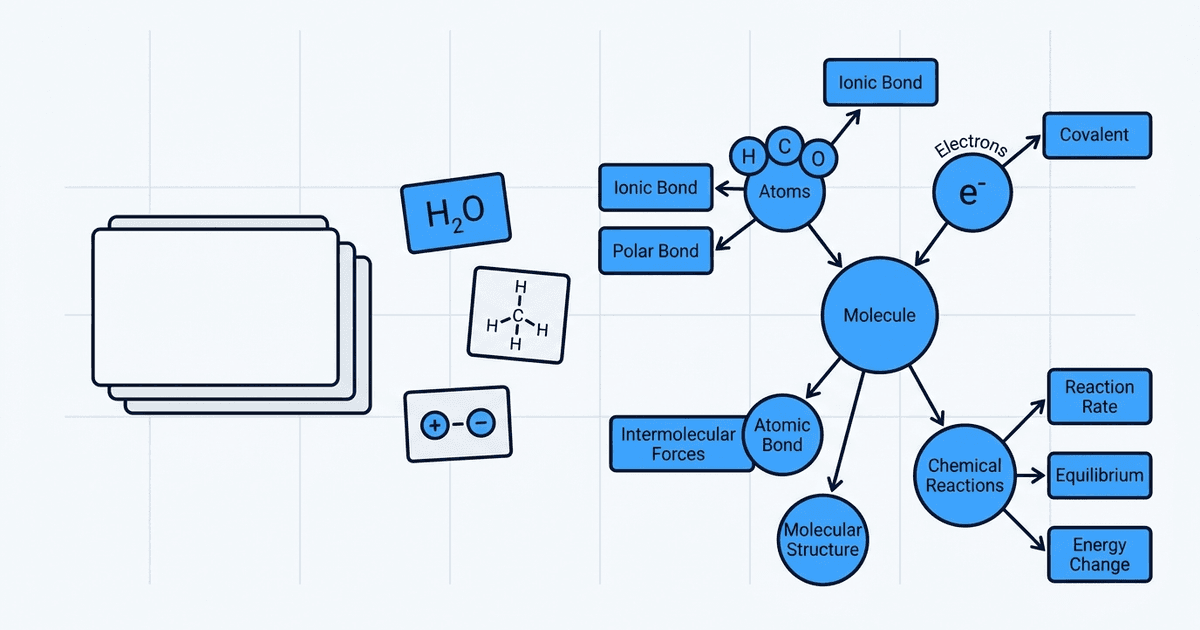
Direct answer: Understanding chemistry in depth means you can explain why a reaction happens, predict what changes when conditions shift, and connect symbols on the page to particles in motion—not just recall a memorized procedure. Memorization gets you through a drill; understanding gets you through a lab question nobody rehearsed.
Many students who say chemistry is "all memorization" are actually memorizing without a mental model. They can balance an equation they have seen, name functional groups from flashcards, then freeze when the exam asks why a product forms, what happens if temperature drops, or how two ideas from different chapters combine. That gap is rarely about talent. It is usually a study-method gap.
Memorization vs. Understanding: What Actually Differs
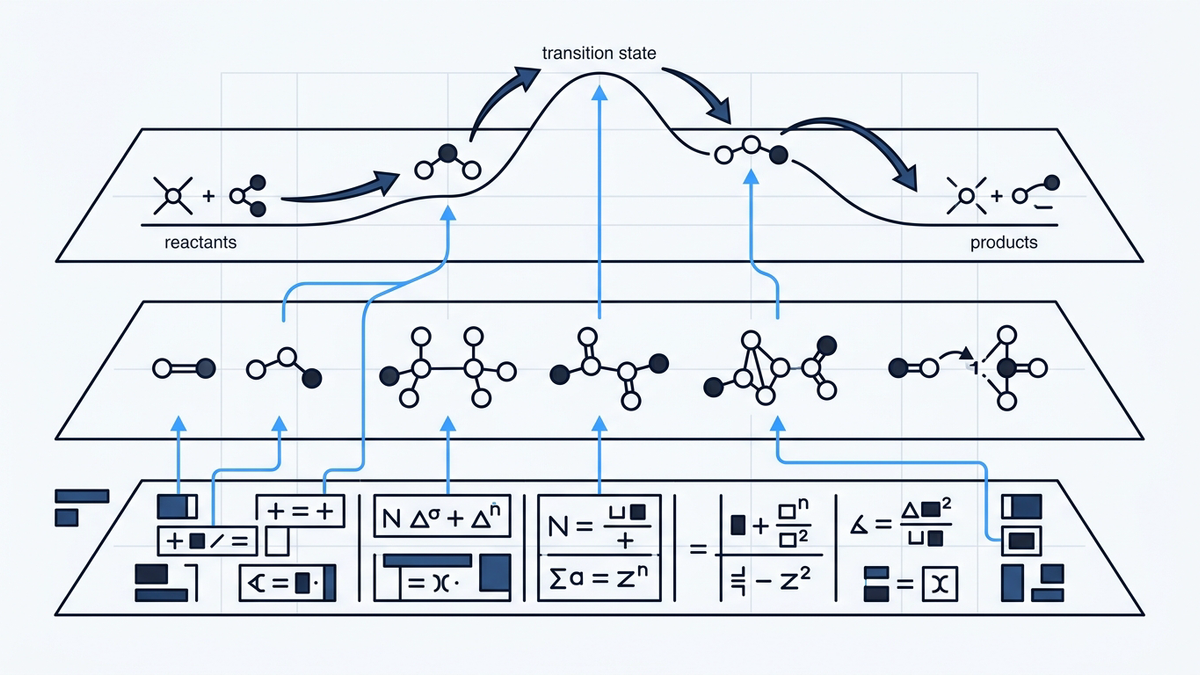
Memorization stores labels and recipes: polyatomic ion charges, solubility rules, the steps for stoichiometry, reagent names in organic synthesis. That storage is useful—working chemists still memorize key facts. But memorization alone treats chemistry like a phone book: you can look up entries, not write new chapters.
Understanding stores relationships: how a balanced equation conserves atoms, why electronegativity drives bond polarity, which electron movement makes a mechanism arrow legal, how Le Chatelier's principle follows from collision theory. When you understand, you can derive a trend you forgot, sanity-check an answer against particle behavior, and transfer ideas to unfamiliar contexts.
A quick self-test after any section: close the book and ask (1) what physical story the symbols tell, (2) what would change if concentration, temperature, or catalyst changed, and (3) how you would explain it using balls-and-sticks, not jargon. If you can only recite steps, you are still at the memorization layer.
Three Layers of Chemistry Mastery
Think of depth as a stack—not a single switch.
Layer 1 — Symbolic fluency. You can balance equations, convert moles, read periodic trends, and name compounds. Fluency matters; it frees working memory for harder decisions. But fluency without a particle picture collapses when the problem is phrased differently.
Layer 2 — Particle-level structure. You visualize atoms, ions, molecules, and electrons. You know bonds as shared or transferred electron density, reactions as rearrangements of nuclei and electrons, and energy changes as bonds breaking and forming. This layer turns isolated facts into a map you can zoom into.
Layer 3 — Prediction and mechanism. You propose products, justify regioselectivity, sketch curved arrows, and estimate whether a process is favorable. Labs, AP free-response, and real research live here.
Study tactics should climb the stack deliberately. Do not skip Layer 1—but never stop at Layer 1.
Always Ask: "What Are the Particles Doing?"
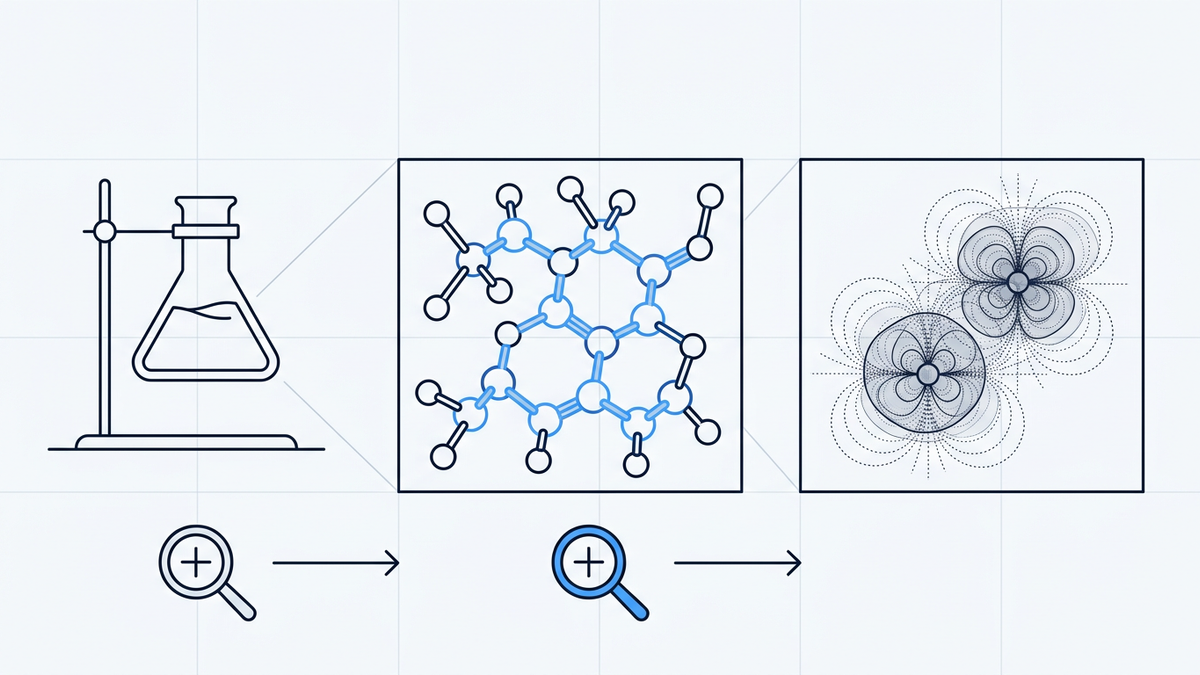
The single most powerful question in introductory and organic chemistry is deceptively simple: what are the particles doing? Symbols are shorthand. Depth means translating every line back to motion.
- In stoichiometry, atoms are conserved; coefficients count particles in fixed ratios.
- In gas laws, particles collide with container walls; pressure tracks collision frequency and force.
- In equilibrium, forward and reverse processes continue; the macroscopic "balance" is dynamic.
- In acid–base chemistry, protons transfer between partners; stronger acids donate more readily.
- In organic mechanisms, electron pairs move; curved arrows show where electron density flows.
When stuck, redraw the scene at the particle level before hunting for a formula. Formulas become reliable only after the picture is clear.
The Observation Loop: See, Model, Predict, Test
Chemists learn like experimentalists even at a desk. Use this loop on every new idea:
- Observe the claim (a trend, a reaction, a rule).
- Model it with a particle diagram or energy story.
- Predict an outcome if one variable changes.
- Test the prediction with a practice problem, simulation, or lab thought experiment.
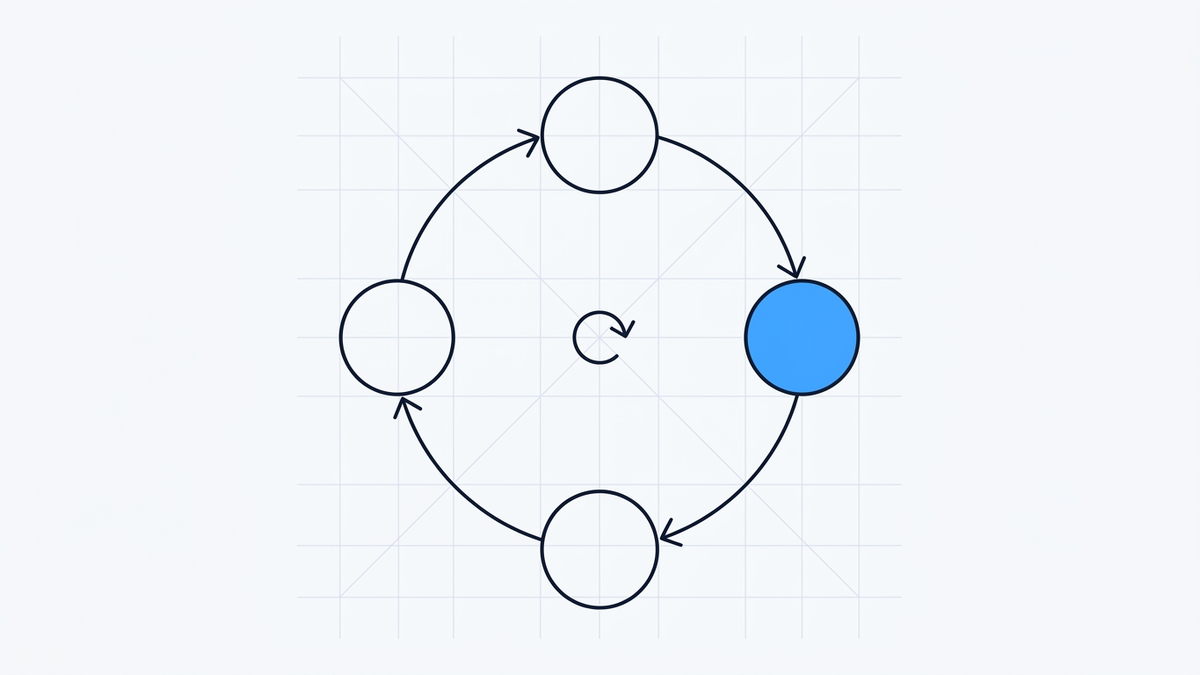
If your prediction fails, you have found a precise gap—exactly where to reread. Failed predictions are data, not embarrassment.
Mechanisms Are Stories, Not Arrow Tricks
Organic and physical chemistry punish arrow memorization. Curved arrows are notation for electron movement. Before copying a mechanism from a solution manual, narrate it:
- Which atom is electron-rich? Which is electron-poor?
- Why does the nucleophile attack there?
- What intermediate is reasonable?
- What would happen if the solvent were different?
Cover the solution, sketch your own arrows, then compare. Change the substituent: does your story still predict the major product? Mechanism problems are comprehension checks disguised as drawing exercises.
Why "More Practice Problems" Sometimes Fails
Repetition helps—until it becomes pattern matching without models. Watching a worked solution is passive; producing one is active. After studying an example, close the book and rebuild it from a blank page. Alter one condition: does your reasoning still hold?
Alternate forward practice (predict products) with backward practice (given a product, what starting material and reagents?) and error analysis (find the deliberate mistake in a flawed mechanism). These modes force structure, not just final lines.
Common Traps That Feel Like Understanding
- Flashcard fluency: you recall terms, but cannot connect them in a new scenario.
- Algorithm chasing: you plug into formulas without knowing what each variable represents physically.
- Rule lists without reasons: "like dissolves like" stays a slogan instead of an intermolecular-force story.
- Color-change magic: you remember that a indicator shifts, not why protonation changes absorption.
- Solution tourism: copying step-by-step apps without closing the tab and redoing the problem yourself.
Each trap mimics progress. The antidote is the same: close resources, draw particles, predict, verify, reflect.
A Weekly Study Rhythm for Depth
Before lecture: skim learning objectives; note which ideas feel like labels versus stories.
After lecture (same day): twenty minutes of retrieval—sketch one mechanism or process from memory, state one definition in plain language, write one sentence on "why this matters physically."
Problem-set days: attempt fresh problems before rereading notes; use references only after an honest attempt.
Weekly consolidation: one page linking this week's topic to prior units—equilibrium to kinetics, bonding to polarity, thermochemistry to spontaneity.
Before exams: mixed problem sets spanning old units. Interleaving feels harder and works better than blocking by chapter.
Using Tools Without Replacing Thinking
Molecular viewers, solvers, and videos can clarify geometry and check arithmetic, but depth requires you to carry the model. A useful rule: after any automated help, close the tab and rebuild the explanation on paper, narrating what each particle is doing.
For syllabus-aligned practice that tests whether you understand relationships in your own materials—not generic trivia—Studeum can generate quizzes and flashcards from your PDFs and notes. Use them to find gaps early: missed quiz items become a targeted reading list, not a surprise on exam day.
Questions to Ask on Every New Topic
- What is the simplest particle picture of this process?
- What is a non-example (looks similar but different mechanism)?
- What energy or entropy story makes the direction plausible?
- Which earlier unit is this a special case of?
- If the professor changed temperature, concentration, or catalyst, what would shift?
Keep these questions in the margin. Over a semester they train you to think like a chemist, not like a deck of flashcards.
When to Seek Human Help
If the same misconception survives three honest attempts, schedule office hours with one specific gap—a step in a mechanism, a definition of conjugate pairs, a drawing of hybridization—not "I don't get chapter seven." Tutors and professors can dismantle a precise misunderstanding quickly; vague distress consumes time.
The Long Game
Depth is not slower forever. Early weeks feel heavier because you are building schemas—mental file systems for particles, energy, and electron flow. Later topics snap in faster when they attach to structures you actually understand.
Memorization gets you through tomorrow's quiz. Understanding gets you through next semester's course, the lab where the procedure changes, and the career where nobody labels problems by textbook chapter.
Choose one reaction tonight. Draw the particles, narrate the electron movement, predict one change if conditions shift, and attempt one problem without looking. That ten-minute loop, repeated, is how memorization graduates into mastery.
Last updated: June 28, 2026.